Showing posts with label book. Show all posts

September 11, 2013

The mythical man month - the tar pit

Preface


It's been a while since I wrote something, work, university and life in general have kept me busy enough to forget that from time to time it is required for me to spare some words in any kind of medium. Just for the fun of doing it.

Then I just started reading the book The Mythical Man Month by Frederick P. Brooks because I found in many places that it is a mandatory reading for software development in general and I started reading it to find out what it has on it.
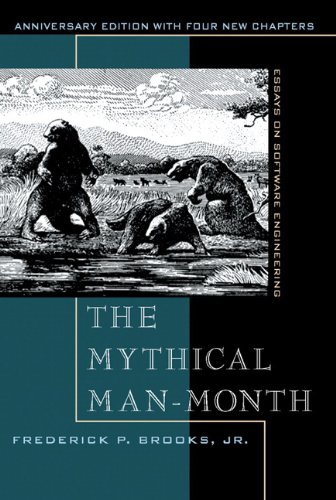


Initially I was just a little bit skeptic about the fact that a book so old (in software-related terms) could have some content for me to be interested.

But after finishing the first chapter I realized that this is not just only a very interesting book, but an invaluable source of data, techniques, practices and tales about how software engineering has been done in the words of the great Frederick P. Brook.

So as I identify this book as something I want to remember, I'm going to write down my thoughts in a chapter-by-chapter basis, pointing the things I have experienced related to them.

The Tar Pit

In this chapter its author identifies that in many senses large systems development can be compared to a huge tar pit where incredibly strong creatures have found their death. 

It defines in a very interesting way programming systems product as:
  • A program, a software product that can be developed by small teams, a simple application (i.e. cat).
  • A programming product, a software product that can be extended or used for the programming of other systems, a library component (i.e. SQLite).
  • A programming system, collection of interacting programming products, I identify it as a basic operating system (i.e. Minix).
  • A programming system product, a collection of interacting programming products that could used and extended by anybody, I identify it as a complete operating system (i.e. Linux)
Based on such classification it describes how systems programming is a craft that has joys and woes inherent of software development, that is impossible to develop something without having limited resources, budget, time and collaboration. But when ones get things done you can express with great honor that you survived the pit. 

April 10, 2012

SE books you must read: Agile Principles, Patterns, and Practices in C#

As a disclaimer, I'm a Java developer, but this book can't be left aside. If you are a follower of the Clean Code movement this is the right book for you. Perhaps the most 'engineer-oriented' book written by Robert C. Martin and Micah Martin.

It covers several concepts about agile development, design patterns, programming, anti-patterns and some code katas to have fun with.


[ Agile Principles, Patterns, and Practices in C# ]

October 19, 2011

SE books you must read: Effective Java

Although this book is kind of old, is still valid. All its concepts and best practices are still being used and its author is an authority in the development world > Joshua Bloch.

This was the first book I read when I got into professional development, and believe when I say that is one of the mandatory books to read if you want to write something functional in Java.


Effective Java at Amazon

PS: I would like to share the ebook version of it, but I'm not sure about the licensing/copying policies.

October 10, 2011

Why reading is important

I had a long conversation today with a very close uncle, he's one of the most knowledgeable persons I've ever met. He learned to read and write on his own, while working and raising a family.

Right now he's in his 70s but the topics he shares are amazingly interesting, starting from Greek mythology, wars, and ending up with urban legends.


Perhaps his wisdom is the result of many years of experience and living, but I couldn't say. So tonight I asked him about his stories, where they come from? how did you get so good at telling them? how can you remember so many things?

His answers were short and concise, most of the stories were taken from other people, some others are life stories where he was involved, and some others are taken from books. But at the end he told me something that I can't leave aside:

"No matter how long you live, the world is big enough to leave you abandoned if you don't cope with it, read as many books as you can. Because there's something  you can always rely when all your senses start failing, your memory. Sometimes it can trick you, but with a little of practice you can train that little bastard...".

That's something that always has intrigued me, I know a lot of people who reads because they have to, or because they don't know what else to do. Books are the best source of information in world (and digital books count as books), I can't understand how so many people can avoid history, stories, articles and tales just because they prefer to watch it on TV or when a movie is released. It's a waste of potential, human beings should know they environment and what's happened in the world before us, we have to learn history, science, literature, etc.

As the great Steve Jobs said once "Stay foolish, stay hungry".

September 21, 2011

SE books you must read: The Pragmatic Programmer

Once I started working of professional software development, I was eager to learn what the world was doing at the time. I had left university and working for a considerable payment was new for me, I wanted to deserve it.

Then I started reading a lot, several books about programming an engineering, some of them were obsolete and a complete waste of time. But every once I found a jewel, and this is a very good one:


Every person getting into software development should take a look at this book, I'm not saying that everything it's written in it has to be followed religiously, but it has very good advices and practices.